
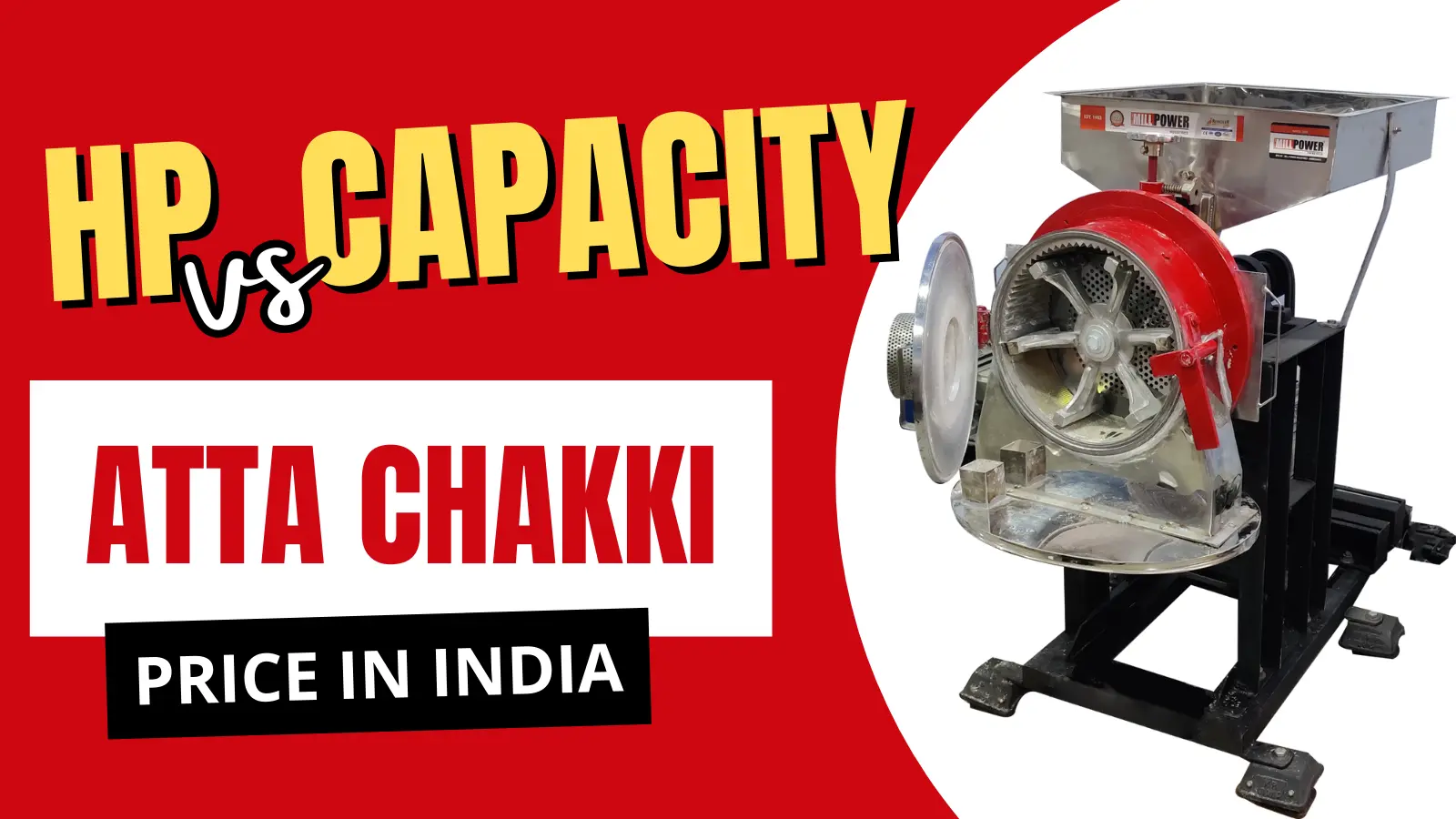
Looking for the latest atta chakki price list in India? This guide compares HP vs capacity, machine types, and price ranges for shops and mini flour mills, helping you choose
14 min Read
17/02/2026
Atta Chakki & Flour Mill
The atta chakki price list in India ranges from ₹14,000 for 1 HP domestic machines to ₹1.8 lakh for 15 HP commercial units. For shops, 3–5 HP atta chakki machines priced between ₹33,500 and ₹72,000 are most suitable, while mini flour mills generally use 7.5–15 HP machines with capacities of 60–180 kg per hour.
• 1–2 HP: Home and micro grinding
• 3–5 HP: Kirana shops and tiffin services
• 7.5–10 HP: Busy shops and small flour mills
• 15 HP: Mini flour mills and higher volume setups
Shopping for an atta chakki often starts with the same question. What’s a realistic atta chakki price list in India by HP and capacity. Prices depend on motor power, build quality, and output per hour. Domestic 1 to 2 HP stoneless mills usually sit under ₹20,000 to ₹35,000. Commercial 5 to 10 HP vertical stone machines span roughly ₹52,000 to ₹1,18,000 as of 2025, with 15 HP units moving into the ₹1.2 to ₹1.8 lakh band.
Here’s a direct answer for quick comparison. Domestic 1 to 1.5 HP machines cost about ₹11,700 to ₹18,000 and deliver 10 to 15 kg per hour. Commercial 5 HP runs ₹52,000 to ₹72,000 for 40 to 50 kg per hour. 7.5 HP lands near ₹58,000 to ₹68,000 for 60 to 65 kg per hour. 10 HP ranges ₹68,000 to ₹1,18,450 for 100 to 120 kg per hour.
In a typical kirana lane, the shop owner hears the hum of the mill, sees steady flour output, and wonders if a higher HP will pay back in less bottleneck on busy mornings. That’s the practical lens used here. Capacity that matches your daily demand, a motor that stays cool and steady, and a build that doesn’t rattle after a year.
Motor HP drives both capacity and machine category. Domestic stoneless mills focus on convenience and safety at lower horsepower. Commercial vertical stone mills use larger emery stones with 5 to 10 HP motors for sustained output. Price slides up with thicker frames, larger stones, double chambers, and higher duty cycles. This atta chakki price list in India reflects typical market rates seen across manufacturers and dealers in 2025. This atta chakki price list in India is prepared using current market data from manufacturers, dealers, and commercial mill suppliers.
Capacity in kg per hour is the second lever. The jump from 15 kg per hour to 60 kg per hour requires not just a stronger motor but a heavier chassis, better bearings, and often stronger belts and pulleys. Build quality matters. A tighter, heavier frame reduces vibration and noise, and that usually shows up in the price tag. Product support matters too. Short warranty and scarce spares can turn a low sticker price into a high lifetime cost.
People often ask for a simple rule. Buy for the busiest hour you have, not the average day. That single shift in thinking tends to keep queues shorter and motors happier.
In India, a 1 HP atta chakki delivers around 15 kg per hour and is mainly used for domestic stoneless grinding. Its price ranges between ₹11,700 and ₹18,000. A 1.5 HP machine provides 10 to 15 kg per hour capacity and is also suitable for domestic use, priced between ₹15,300 and ₹16,000.
A 2 HP atta chakki produces approximately 20 kg per hour and is suitable for semi-commercial applications, with prices ranging from ₹31,250 to ₹32,500. A 3 HP model offers around 25 kg per hour output and is ideal for small shops, typically priced between ₹33,500 and ₹38,000.
For shop and low-volume mill use, a 5 HP machine delivers about 40 to 50 kg per hour and costs between ₹52,000 and ₹72,000. A 7.5 HP atta chakki produces around 60 to 65 kg per hour and is suitable for mini flour mills, priced between ₹58,000 and ₹68,000.
A 10 HP machine provides 100 to 120 kg per hour output and is commonly used in mini flour mills, with prices ranging from ₹68,000 to ₹1,18,450 depending on build and stone type. A 15 HP atta chakki delivers 140 to 180 kg per hour capacity and is suitable for higher-volume mills, with a price band of ₹1,20,000 to ₹1,80,000.
Prices are indicative as of 2025. Real quotes vary by stone size, chamber type, motor brand, and warranty. Cross-check current offers before buying.
Domestic 1 HP stoneless mills suit homes and micro setups. Typical price sits between ₹14,000 and ₹18,000 with some branded 1 HP at ₹11,700 for an automatic model rated 15 kg per hour. Capacity claims vary by design and stone set. For occasional grinding and mixed grains, 1 HP works fine if patience is part of the plan.
Two and three HP machines bridge domestic and small commercial tasks. Expect ₹31,250 to ₹32,500 for 2 HP and ₹33,500 to ₹38,000 for 3 HP. Output near 20 to 25 kg per hour suits small retailers who grind on request and want minimal noise and easier single phase installation. This tier is where reliability starts to beat shiny features.
These are the dependable workhorses for micro businesses. If daily demand climbs past 30 kg, the next tier often pays back in time saved and fewer service calls.
Five HP vertical stone mills are popular with kirana shops. Price starts around ₹52,000 and can reach ₹72,000 as build quality and stone grade improve. Output sits near 40 to 50 kg per hour. Single phase options simplify power in shop locations. Three phase variants run smoother but need an industrial supply.
Ten HP is the classic mini flour mill spec. Price spans ₹68,000 at the entry end to ₹1,18,450 for diamond stone and double chamber designs. Capacity of 100 to 120 kg per hour keeps small mills moving through wheat, bajra, and chana without overheating the motor or stalling under load.
Fifteen HP enters higher volume territory. Typical market quotes cluster between ₹1.2 and ₹1.8 lakh as of 2025, depending on stone diameter, chamber type, and enclosure quality. Expect 140 to 180 kg per hour from well built vertical units. Treat this tier like a capital purchase. Demand, power stability, and local service support matter as much as sticker price. Editor verified band.
At 5 to 10 kg per hour, a 1 to 1.25 HP domestic stoneless unit covers routine home flour and occasional small batches. The price sits between ₹14,000 and ₹17,000. Capacity can dip with tougher grains or finer mesh requests. For micro businesses, schedule short runs to avoid overheating and keep stones aligned.
This band fits 1.5 to 3 HP. Expect ₹15,300 to ₹38,000 for machines that handle on demand grinding without noise spikes. Shifting to 3 HP offers a stable 25 kg per hour and reduces queuing. A shop owner once put it plainly. “Don’t underbuy the motor.” That advice saves time on busy evenings.
Here the price curve climbs with 5 to 7.5 HP machines. Output of 40 to 65 kg per hour covers small mill slots and daily shop flow. Expect ₹52,000 to ₹68,000 for standard and diamond stone designs. As output rises, look for heavier frames, balanced stones, and easy access panels for cleaning.
A 1 HP atta chakki produces around 15 kg per hour and consumes approximately 0.7 to 1.0 units of electricity per hour. It generally operates on single-phase power and is suitable for domestic use.
A 1.5 HP machine provides 10 to 15 kg per hour output and consumes about 0.75 to 1.2 units per hour, operating on single-phase supply.
A 3 HP atta chakki produces nearly 25 kg per hour and consumes approximately 2.0 to 2.5 units per hour, usually running on single-phase power.
A 5 HP machine delivers 40 to 50 kg per hour output and consumes around 3.5 to 4.5 units per hour. It may operate on single-phase or three-phase power depending on configuration.
A 7.5 HP atta chakki produces about 60 to 65 kg per hour and consumes approximately 5.5 to 6.5 units per hour, typically requiring three-phase supply.
A 10 HP machine delivers 100 to 120 kg per hour output and consumes around 7.5 to 9 units per hour under full load, operating on three-phase power.
A 15 HP atta chakki provides 140 to 180 kg per hour capacity and consumes approximately 11 to 13 units of electricity per hour. It runs on three-phase power and is suitable for heavy commercial operations.
Electricity use is a practical estimate based on typical motor load and real world duty cycles. Actual draw depends on grain type, mesh, and machine health.
Electric mini mills for home start at ₹14,000 and stretch to ₹18,000 for 1 HP, while 1.5 HP lands near ₹15,300 to ₹16,000. These models focus on compact cabinets, stoneless grinding, and easier cleaning. For small craft businesses making multigrain mixes, plan shorter runs and cool down gaps to protect motors and boards.
Single phase is usually more convenient at the shop level. Three phase offers smoother torque at higher HP and can run cooler under load. Price differences on the machine itself are modest compared to the cost of securing a three phase connection. For 5 HP, single phase models around ₹52,000 to ₹62,000 are common. Three phase variants often quote similar machine prices, with installation context deciding the total bill.
These segments map to daily demand patterns. If the queue builds from 5 pm to 8 pm, a higher HP often pays for itself by keeping customers moving and motors cool.
Local manufacturers often deliver strong value with standard stone sizes and solid frames. Branded lines sometimes add better finishing, tighter tolerances, and faster access to spares. Series types matter more than logos. Vertical stone mills for commercial use. Stoneless cabinets for homes. Double chamber pulverizers for multi grain switching and finer mesh control.
Domestic units commonly advertise 6 to 12 months warranty. IndiaMART listings show 7 to 12 months on some 1.5 HP models. Commercial mills may bundle shorter coverage on stones and belt parts. The most valuable promise is fast access to stones, belts, bearings, and boards within your city. Service within 48 hours is worth paying for.
Using a verified atta chakki price list in India helps avoid overbuying HP and reduces long-term operating cost.
1. Estimate peak hourly flour demand
2. Match required capacity (kg/hr)
3. Select HP that supports continuous load
4. Confirm power phase availability
5. Compare service support and spare parts access
Kirana shops and small flour businesses
A quick scenario. A mill startup runs 10 HP for wheat mornings and chana afternoons. The aroma shifts, the mesh tightens, and throughput stays steady when stones are balanced and belts are tensioned right. The little details keep a busy day predictable.
This updated atta chakki price list in India helps shop owners and mini flour mill operators compare HP, capacity, and budget before investing.
Check current listings and availability with recognized sellers and manufacturers. IndiaMART has live listings for domestic models with specs and warranty notes. Branded manufacturer sites and local dealers share updated price bands for commercial stone mills. Always ask for stone size, motor make, warranty, and spare kit pricing in writing.
The key takeaway. Match HP to your heaviest hour, not your quietest day. That single choice tends to lower queues, reduce wear, and protect your electricity bill. Next step. Shortlist 2 to 3 models in your capacity band, compare service terms, and request a vibration and output test before finalizing. This is how shops and mini mills avoid buyer’s remorse.
The best choice is the series and build that match your workload. For shops, 5 to 10 HP vertical stone machines from reliable local manufacturers often deliver strong value. Branded lines can add better finishing and easier access to spares. Compare motor HP, stone diameter, frame weight, and service reach rather than logos.
Fifty kilogram sacks are a wholesale format and pricing depends on wheat mandi rates, brand, region, and transport. Retail shelves rarely stock 50 kg for consumers. Expect quotes to vary week by week and check local suppliers or mill distributors for current rates. Needs confirmation with live market data.
A 1 HP automatic Maharaja domestic model is listed around ₹11,700 with rated capacity near 15 kg per hour as per a current IndiaMART entry. Always confirm with the seller for warranty and inclusions.
Twenty kilogram atta packs are less common in modern retail and often sold to shops and eateries through distributors. Price varies by brand and flour grade. Check your regional distributor or brand website for current MRP and bulk rates. Needs confirmation with live market data.
A 3 to 5 HP atta chakki is best for most kirana shops, offering 25–50 kg per hour output with manageable power consumption.
Electricity consumption depends on HP. A 5 HP atta chakki typically uses 3.5–4.5 units per hour, while a 10 HP machine may consume 7–9 units per hour under full load.
Three-phase atta chakki machines run smoother at higher HP and are better for continuous commercial use. Single-phase machines are suitable for smaller shops where three-phase power is not available.
Pulverizer King
B 31 Arvind Estate, Nr. Star Hospital, Bapunagar, Ahmedabad Gujarat IN 380025
Copyright ©️ 2026 Pulverizer King